The Blueprint: Why We Train the Way We Train
Anthony Musemici • March 1, 2026
The Blueprint: Why We Train the Way We Train
Let me ask you something. When you picture a fit person, what do you see?
Chances are you picture someone who runs. Maybe they run a lot. Maybe they do marathons. Or maybe you picture someone with a lot of muscle, someone who looks like they live in the weight room. Our culture has spent decades telling us that endurance is fitness, or that size is fitness, or that a low body fat percentage is fitness. Pick your poison.
The problem is none of those things, on their own, actually define fitness. A marathon runner can be brought to their knees by a workout that requires any meaningful amount of strength. A powerlifter can be gassed after two minutes of sustained effort. Looking a certain way in the mirror tells you almost nothing about what your body can actually do.
So what is fitness? That's not a rhetorical question. It's one worth actually answering, because the answer determines everything about how and why we train.
At CFBT, we train to be capable. Not just strong, not just fast, not just lean. Capable. Capable across a broad range of physical demands, expected and unexpected, familiar and completely new. The goal is to build a body that doesn't have a glaring weakness, one that can handle whatever gets thrown at it. That's the standard we're chasing. I told someone the other day "My goal is to make you hard to kill"
And behind that standard is a structure. It's called the Theoretical Hierarchy of Development, and once you understand it, everything we do in programming will make a lot more sense.
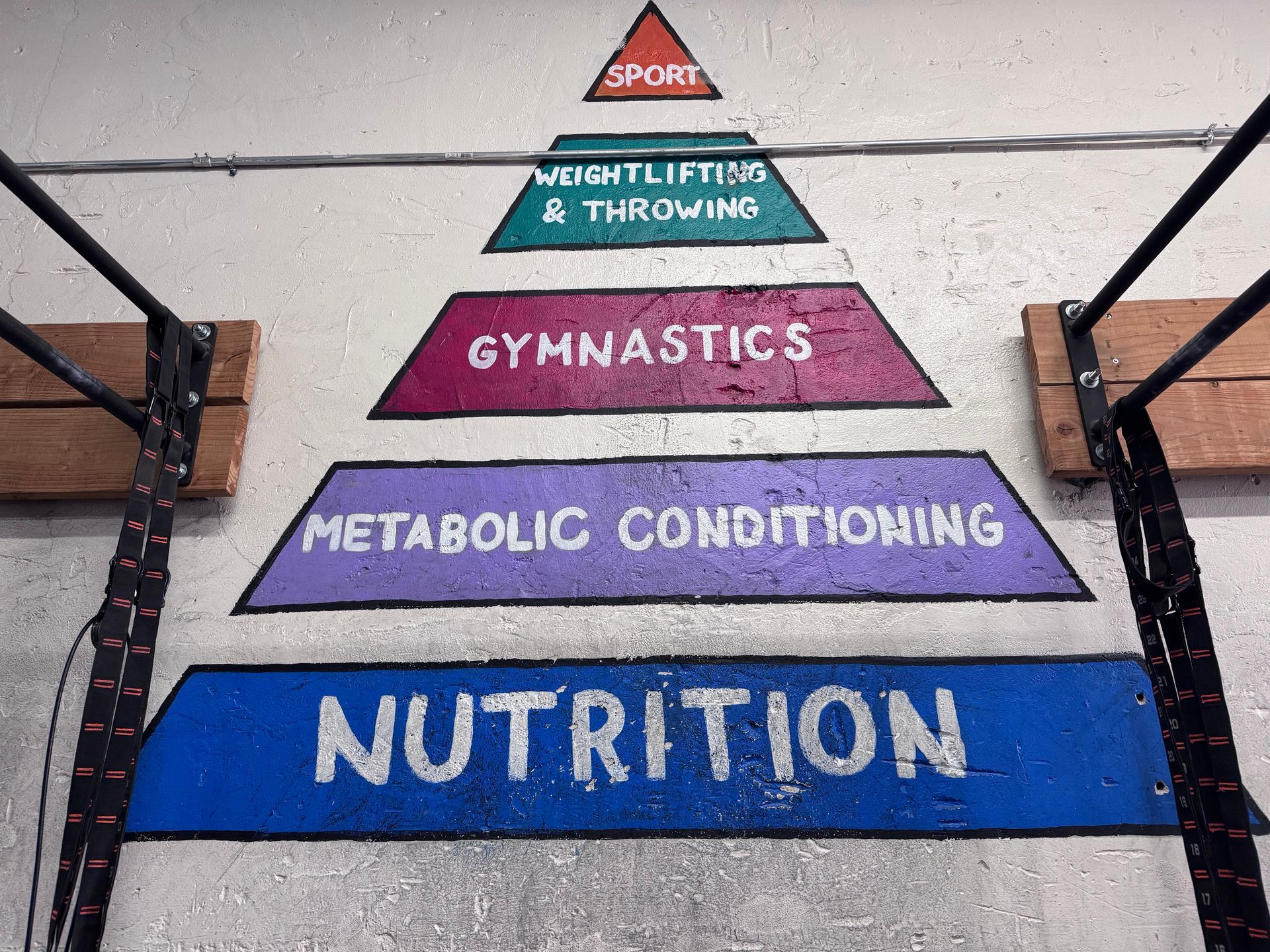
This is the pyramid that is on our wall: Five layers. Each one depends on the one below it. Strength at the top means nothing if the foundation is cracked. Here's how it builds.
Nutrition
is the base, and it is non-negotiable. Before a single rep is counted, before the clock starts, before you walk through the door, what you eat is either supporting your development or quietly working against it. Nutrition isn't about being perfect. It's about giving your body the raw materials it needs to respond to training. Protein to rebuild muscle. Carbohydrates to fuel effort. Fat to support hormonal function. When that foundation is shaky, everything above it is compromised. You can out-train a bad diet for a while. Eventually, you can't.
Metabolic Conditioning
is the second layer, and this is your engine. Not just your lungs, your entire system's ability to produce, sustain, and recover from effort. This is what gets built when we push the pace, shorten rest intervals, and keep intensity high. There are three energy pathways that power everything you do, short explosive efforts, moderate sustained work, and long lower-intensity output. Genuine fitness requires training all three, not just the one that's comfortable. The athlete who only runs long distances and the athlete who only lifts heavy are both leaving enormous gaps in their engine. We train all of it.
Gymnastics
is body control, pure and simple. Pull-ups, push-ups, dips, rope climbs, handstands, pistols. The ability to move, support, and control your own bodyweight with strength, precision, and coordination. This layer gets underestimated more than any other. People want to add weight to the bar before they can move their own body well, and it costs them. Gymnastics builds the upper body strength, the midline stability, and the spatial awareness that makes everything else more efficient. When this layer is underdeveloped, it shows up fast when the workout gets hard.
Weightlifting and Throwing
is where external load enters the picture. The deadlift, the squat, the clean, the jerk, the snatch. These movements are not just strength exercises. They are neurological events. They alter your body hormonally and neurologically in ways that isolation movements simply cannot replicate. A curl works one joint. A clean works everything simultaneously. The movements we prioritize here are the ones that have a direct carryover to real life, to sport, to every physical demand you will ever face. Power generated from the hips. Coordination under load. Speed through a full range of motion. This layer builds athletes.
Sport
sits at the top, and it is where everything comes together. Sport is fitness expressed in real time against unpredictable, unscripted demands. It is also the most honest mirror we have. Gaps in any layer below show up immediately in sport. You cannot fake your way through it. This is why we encourage athletes at CFBT to play, compete, and test themselves outside the gym. Not to replace training, but because sport develops what structured training alone cannot: adaptability, instinct, and the ability to perform under pressure.
Here is what matters most about this pyramid. You do not get to choose the order. Nature enforces it. A weak nutritional foundation limits your metabolic capacity. Poor body control limits how much you can safely load. An underdeveloped engine limits your ability to express strength when it matters. Every layer feeds the one above it, and every deficiency at a lower level puts a ceiling on everything higher up.
This is not a theory we invented. It is a framework built on exercise science and validated by the performance of real athletes across every background and ability level. It is the reason we deadlift and row and sprint and climb ropes and work on handstands. Not because it looks impressive or because it is trendy. Because it works, and because every piece of it has a purpose inside a larger system.
So, the next time you are in the middle of a workout that is humbling you, look at that pyramid. You are not just getting through a workout. You are building something, layer by layer, with every rep you finish and every day you show up.
That is the blueprint. And you are in the middle of building it.
More to come.
This is my first blog post. Ideally, it’s one of many to come. I have a long list of topics I want to explore or, ramble about; training, longevity, strength, consistency, coaching, community, and how all of this fits into real adult lives. But before getting into any of that, it makes sense to start with something more basic: What do we actually mean when we say “fitness”? And just as importantly: why do we train the way we do? A lot of confusion around fitness comes from the fact that people are often talking about very different things while using the same word. So let’s clarify. A Practical Definition of Fitness In 2002, Greg Glassman wrote an article called *What Is Fitness?* It became foundational to how CrossFit Bridge & Tunnel and, gyms like ours, think about training. The definition is simple: Fitness is increased work capacity across broad time and modal domains. That sounds technical, so let’s translate...in simple terms... Being fit means you can: Do more work For longer periods and short bursts of time Across many different kinds of tasks In other words, fitness isn’t about being good at one thing, it is about being capable across many things. Strength matters. Endurance matters. Power matters. Coordination matters. So does balance, speed, stamina, flexibility, and accuracy. Fitness is not specialization. Fitness is versatility. Why This Matters for Adults Most adults don’t need to be the best in the world at anything physical. What they need is to be: Strong enough to lift, carry, and move objects Conditioned enough to climb stairs, walk distances, or keep up with life Coordinated enough to move safely and confidently Resilient enough to recover, adapt, and keep going year after year Real life doesn’t ask you to perform one task repeatedly under perfect conditions. It asks you to do unknown tasks, at unexpected times , often when you’re already tired. That’s why we train broadly. The “Unknown and Unknowable" One of the most useful ideas from Glassman’s article is the concept of preparing for the “unknown and unknowable.” You don’t train because you know exactly what challenge is coming. You train so that when something does come, you’re more capable of handling it. That could mean: Carrying groceries up multiple flights of stairs Getting yourself off the floor Managing stress and fatigue Staying independent as you age Helping someone move Fitness, in this sense, is preparedness. Health Is a Continuum Another important idea is that health isn’t a fixed state. It exists on a continuum. On one end is sickness In the middle is wellness On the far end is fitness Training consistently, intelligently and progressively moves you along that continuum. Not toward perfection. Toward capacity. Why We Train the Way We Do At CrossFit Bridge & Tunnel, we don’t chase extremes. We train: A wide variety of movements Across different time domains At loads and intensities appropriate to the individual The goal is not to crush yourself. The goal is to build a body that works well, holds up, and keeps working over time. Consistency beats intensity. Quality beats chaos. Long-term thinking beats short-term results. A Starting Point This post isn’t meant to answer everything. It’s meant to establish a foundation. If we don’t agree on what fitness is, then none of the programming, coaching, or philosophy that follows will make much sense. This is the framework we use. It’s the lens through which we coach. And it’s the reason our training looks the way it does. More to come...